The Life Stages of a Writer

We often think of a life in chapters. This organization makes sense, even for those who don’t consider writing to be their dedicated vocation or life’s work. A poem cycle I am drafting features this conceit: each poem is a chapter, and each chapter is written with the conventions/tropes/lens of a different genre (e.g.: fantasy, horror, romance, etc.). It is strange to think about how my life would be organized otherwise, if I weren’t a writer. I cannot help but think back to certain life events through the lens of my reading/writing and creative impulses/obsessions at the time. My whole identity is bound up and defined this way. Because of this, I’ve paid close attention to how my tastes have changed over the years, how my specific motivations for writing have changed. Through this mapping, I can also see how my priorities have shifted as a human. I wonder if other writers and creatives segment out their lives in a similar way, if any of the organization to these chapters have more universal qualities than I realized.
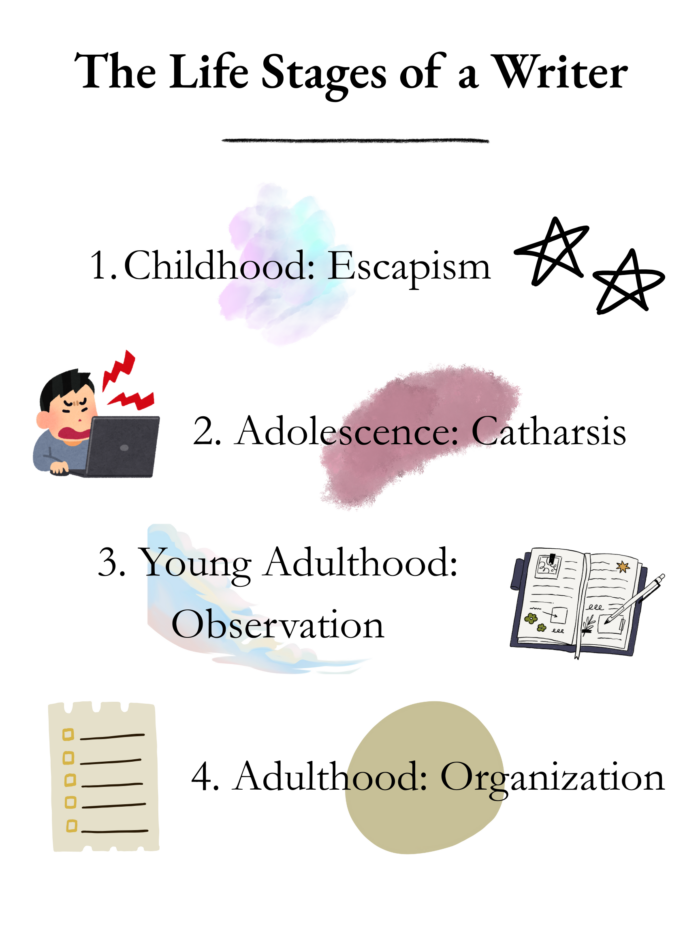
Here I have mapped out my life stages as defined by my primary motivation for my writing-being during each period.

1. Childhood: Escapism

I was a quiet child with a loud imagination. I was an only child for the first eight years of my life. Writing was a means to entertain myself and the few others who would put up with my eccentricities and esoteric fascinations. I made books out of construction paper for my mom, I wrote plays for my family. I made up video game character select screens, bestiaries. I wrote because it was exciting; I was always vibrating with ideas and had to put them somewhere. Writing gave me the space to play with them.

2. Adolescence: Catharsis

During my teenage years, I obsessively chronicled my everyday life. Writing became less about dreaming and fantasizing and more about venting and understanding what I was feeling (see: existential angst, confusion, frustration). It became my primary means and preferred method of communication. I kept several online journals (one was read by close friends, others were only for me). I wrote because I was compelled to and I wrote to feel less alone. It was part prayer, part exorcism. This was the obsessive period in that I couldn’t seem to help what I was doing. Along the way, I connected with others online through my writing and ranting into the ether. They certainly put up with me more than I would have.

3. Young Adulthood: Observation

After graduating college with my BA, I felt adrift and uncertain. I knew what I was good at, but I didn’t know how it was going to fit into a career exactly. I was unsure about teaching. I began having severe panic episodes for the first time. I moved away from my everyday online chronicling and instead kept a physical journal to map my anxieties, shown only to my therapist. I was forced to look at myself with more distance, from the outside in. I began to edit for literary journals and publish poems and short fiction. For the first time ever, there was a consideration of audience. My writing became less private and I had to think about what that meant, if I wanted to use a pseudonym. I ended up using a half-pseudonym, which has stuck with me to this day.

4. Adulthood: Organization

My writing and reasons for writing now take on many forms; it’s all about juggling modes and moods. There are so many drafts in so many different places, to-do lists and notes. Writing happens on my phone, on my computer, in the shower, before I fall asleep. Pieces eventually coalesce or don’t. I check tasks off everywhere, I set reminders. There is so much prioritizing. My creative life is much more compartmentalized because it has to be. I strive for coherence in my writing and through my writing.

Who Are You, What Is This?

I used to chronicle my life compulsively via an online journal. In it, you’d find: complaints about high school and college, thoughts on books I was reading (in addition to the ones for school) and movies I was watching, photos with friends who deigned to give me the time of day, and inside jokes that I’ve long forgotten the origins of. This journal was semi-private in that we had to be “friends” first for you to read it and leave comments. The writer Sarah Manguso discusses her obsessive tendencies to document everything in her life in Ongoingness: The End of a Diary and how a certain event (in her case, motherhood) put a freeze on this compulsion. I feel like I used to be obsessive in this same way, but I can’t really pinpoint any one event as to why the compulsion stopped. Maybe it was because everything started moving too fast for me online, too fast to process. Maybe it was because everything and everyone became too scattered in the digital ether. Regardless, the obsession has not been the same. I still jot down notes to myself, mostly lines for future poems, but I don’t really journal much anymore. Manguso used to be scared that she would forget most of the events in her life and that motivated her compulsions, but I don’t have that same fear anymore. I know I’ll forget and that’s okay. Maybe that’s just getting older, that particular acceptance.

This month, my university hosted a reading with Sarah Manguso that I got to attend. Manguso is a writer who started out as a poet, branched out into lyrical and fragmented nonfiction, and is now writing novels. Her cross-genre work has been helpful in how I think about my thesis, which experiments with form and has a lyric essay at the heart of it. She discussed her frustrations in finding the appropriate mode that fits with the project she envisions, and I often find myself similarly frustrated. I got her to sign her newest book. One of the few things I find invigorating at the end of the world: being among writers and people who still believe in writing.

Even though my online journaling has been much more infrequent in recent years, I feel as if most of my writing has been a kind of journaling. Through it, I’ve been able to chart my changing tastes and moods, my affinities. My literary experiments reflect the current obsession I want to contain in a certain space during a certain time. This has definitely become even more apparent through my thesis writing, which relies on the epistolary and the confessional.

A project that I’ve shelved but may return to after graduation: a sequence of poems (or one long poem?) that is part erasure and part revising of old journal entries. This concept may end up proving more self-indulgent than useful in the end, but who knows. Of course, the “who knows” is always what makes it interesting.

Hellos and Goodbyes

October was gone in an instant and November already has one foot out the door. Instead of writing and reading, I was very busy studying for the GRE and applying to MFA programs. I hadn’t done geometry since high school, and hopefully that was the very last time I’ll have to study math again. I had to seek out professors I hadn’t talked to in over a decade for letters of recommendation. I had to refresh their memory of who I was, what I did in their classes, and what I’ve been working on since then. Somehow, I put together a portfolio of my best short fiction. It’s very difficult selecting “the best” of anything. I crafted a statement of purpose, which includes what I write, why I write, what I want out of an MFA, and what I can possibly contribute. These posts by Carmen Maria Machado and Cady Vishniac were essential in figuring all of this out. Thank goodness for gracious writers like them.

I’ve also become an assistant editor at The Review Review. Their site is an invaluable resource to both new and veteran writers alike. I’ve previously written reviews for them. Now I’m coordinating all the interviews with literary magazine editors for the site. It’s become my mission to highlight new journals that seek to publish underrepresented voices, alongside the old journals who have been around for decades.

I received my contributor copies of the Lascaux Prize 2017 anthology. My poem, “Heathens at Thanksgiving,” was a finalist and was included in its pages. You can order a print or digital copy.

Unfortunately, some of the hellos I’ve gotten to say lately have come with goodbyes. This week, we lost my grandma on my dad’s side. Grandma had just celebrated her 90th birthday this year. It is a very unreal feeling when someone you’ve known your whole life is suddenly no longer a part of it. I remember watching The Price Is Right with her when I was little. I remember her excessive cheek kisses and her dance moves at parties. I remember all her Italian-isms: bicciuridu (my little baby), stunad (idiot), gifu? (what’s wrong?). Lots of mangia, of course. How she always cooked huge Italian meals for Christmas, every kind of chicken and pasta, the scungille (shellfish) and bruppu (octopus). How all my little cousins loved the octopus and how I didn’t trust it. I will miss Grandma, but I’m very glad she lived a long life. I’ve got some good genes.

Finding (My) Voice

This isn’t about writing style like you might think, or about carving out my own identity in the literary landscape. This is about actual voice and how I’m trying to change it.

I’ve always been soft-spoken. You’d think by now I’d be used to being talked over, interrupted, and not allowed to finish a thought. But just like the role of the wallflower, you never really get used to it. We like to believe we do, but we never do. The periphery is both comfortable and convenient when you wish to avoid any attention, but that also means people will relegate you to the shadows. It’s difficult when you desire recognition without the spotlight.

I never wished to disturb the universe. I wouldn’t dare, Mr. Eliot. I like harmony and dislike confrontation. I never wish to be an intrusion upon anyone, so I shrug in towards myself. I’ve always kept my head down and concentrated on the sidewalk, never daring to meet a stranger’s gaze.

Friends have noticed how I add “I guess” or “I think” to the end of most sentences, even when I’m a hundred percent certain about something. This is just like how I used to say I’m sorry all the time, even when there was absolutely no reason for me to apologize. Sometimes I’d even apologize when it was clearly someone else’s fault. It was only when I was made cognizant of it that I was able to change this behavior, and even then, it took some practice.

It’s going to take much more practice to free myself of this deep rooted self-doubt. Over years and years, it has become both my vocabulary and my voice. It’s kind of hilarious being a writer who doesn’t believe in the value of his own words.

I’ve been trying to teach myself that my contributions are worthwhile. I’ve been trying to teach myself how to raise my voice so you can clearly hear what I’m saying. It has become a matter of necessity now, especially since it has been brought to foreground by my work life. My editorial job requires me to tell people when they’ve made mistakes, even when I don’t want the confrontation. It requires me to voice confidence when I know I’m right and someone else isn’t–which, as it turns out, is often.

So I lied. I said this wasn’t going to be about writing. But if it’s about voice, then it’s going to be about writing too.

I received this rejection letter:

Dear Joseph Dante,

Thank you so much for sending us this. We love the nuance and patience of this story and the delicacy of this relationship. Unfortunately, this piece doesn’t quite fit the tone we’re developing for Issue 6, but I would love to read more of your work in the future.

We wish you the very best of luck placing this story elsewhere.

I couldn’t help but think, if only it were louder. If only softness wasn’t such a problem. If only we didn’t expect the writing to grab you by the throat.

I’m still learning how to turn up the volume.

On Prose Poetry

Not too long ago, I didn’t know exactly what prose poems were, but I suspected I’d been writing them for a while. I just assumed they were hybrid poems that emphasized the narrative over the lyrical. Apparently I was both right and wrong. In order to better understand what I was doing or what I could do, I read A Field Guide to Prose Poetry, published by Rose Metal Press. As it turns out, I still don’t know exactly what prose poetry is, but that may be the point–this is a kind of literature that resists category. The book is a good starting point nonetheless, as it introduced me to writers who were doing it their own way. One thing that did surprise me here: prose poems tend to be unlineated. They tend to be poems that look like prose on the page, and not vice versa. Many cite Charles Baudelaire and Arthur Rimbaud as early experimenters. I also went away loving Nin Andrews’ writing, and now I have to get my hands on her books too.

Writing that stretches and defies category has always interested me. Lyrical flashes, collaged fragments, memoir disguised as theory, criticism in poetry. It’s often brave and full of surprises. It dismantles and disrupts. It’s inherently queer. Intertextuality as identity, as a reflection of real life.

After reading, I wanted to find more related texts that could expand the possibilities. I searched online for journals that seek to publish prose poetry, which I will share with you here:

Unbroken Journal
Elsewhere
Pithead Chapel
Threadcount
Ghost Ocean
Contemporary Haibun Online

There used to be more, like Sentence, Double Room, and Prose Poem: An International Journal, but all these seem to be defunct now. Let me know if you have any other suggested readings to contribute.