We often think of a life in chapters. This organization makes sense, even for those who don’t consider writing to be their dedicated vocation or life’s work. A poem cycle I am drafting features this conceit: each poem is a chapter, and each chapter is written with the conventions/tropes/lens of a different genre (e.g.: fantasy, horror, romance, etc.). It is strange to think about how my life would be organized otherwise, if I weren’t a writer. I cannot help but think back to certain life events through the lens of my reading/writing and creative impulses/obsessions at the time. My whole identity is bound up and defined this way. Because of this, I’ve paid close attention to how my tastes have changed over the years, how my specific motivations for writing have changed. Through this mapping, I can also see how my priorities have shifted as a human. I wonder if other writers and creatives segment out their lives in a similar way, if any of the organization to these chapters have more universal qualities than I realized.
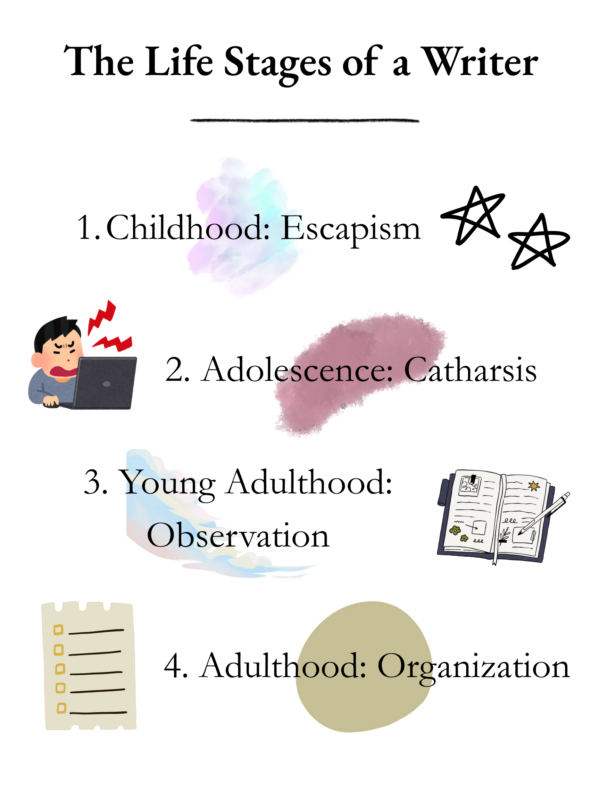
Here I have mapped out my life stages as defined by my primary motivation for my writing-being during each period.
1. Childhood: Escapism
I was a quiet child with a loud imagination. I was an only child for the first eight years of my life. Writing was a means to entertain myself and the few others who would put up with my eccentricities and esoteric fascinations. I made books out of construction paper for my mom, I wrote plays for my family. I made up video game character select screens, bestiaries. I wrote because it was exciting; I was always vibrating with ideas and had to put them somewhere. Writing gave me the space to play with them.
2. Adolescence: Catharsis
During my teenage years, I obsessively chronicled my everyday life. Writing became less about dreaming and fantasizing and more about venting and understanding what I was feeling (see: existential angst, confusion, frustration). It became my primary means and preferred method of communication. I kept several online journals (one was read by close friends, others were only for me). I wrote because I was compelled to and I wrote to feel less alone. It was part prayer, part exorcism. This was the obsessive period in that I couldn’t seem to help what I was doing. Along the way, I connected with others online through my writing and ranting into the ether. They certainly put up with me more than I would have.
3. Young Adulthood: Observation
After graduating college with my BA, I felt adrift and uncertain. I knew what I was good at, but I didn’t know how it was going to fit into a career exactly. I was unsure about teaching. I began having severe panic episodes for the first time. I moved away from my everyday online chronicling and instead kept a physical journal to map my anxieties, shown only to my therapist. I was forced to look at myself with more distance, from the outside in. I began to edit for literary journals and publish poems and short fiction. For the first time ever, there was a consideration of audience. My writing became less private and I had to think about what that meant, if I wanted to use a pseudonym. I ended up using a half-pseudonym, which has stuck with me to this day.
4. Adulthood: Organization
My writing and reasons for writing now take on many forms; it’s all about juggling modes and moods. There are so many drafts in so many different places, to-do lists and notes. Writing happens on my phone, on my computer, in the shower, before I fall asleep. Pieces eventually coalesce or don’t. I check tasks off everywhere, I set reminders. There is so much prioritizing. My creative life is much more compartmentalized because it has to be. I strive for coherence in my writing and through my writing.

Leave a Reply